Reply Chain Hijacking: How Attackers Exploit Existing Email Conversations

Quick Answer
Reply chain hijacking is an email-based cyberattack where criminals compromise accounts or impersonate trusted senders to infiltrate ongoing conversations, distribute malware, steal sensitive data, or trick recipients into revealing confidential information.
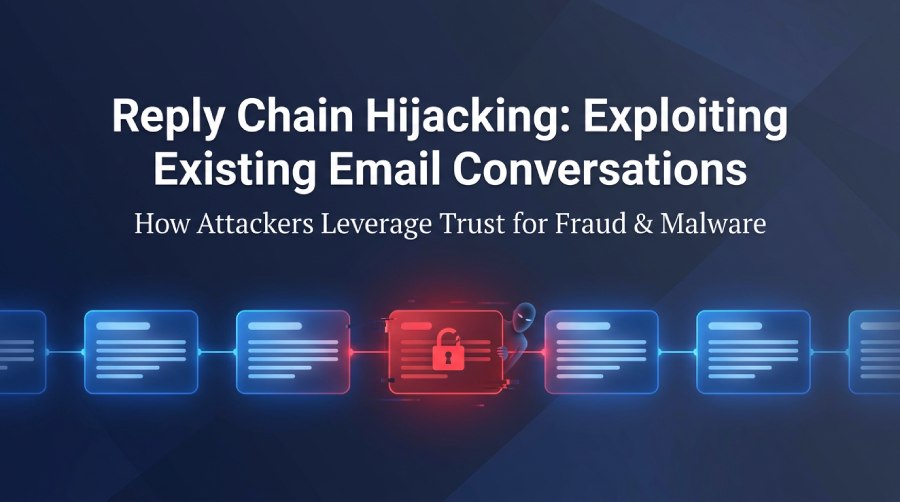
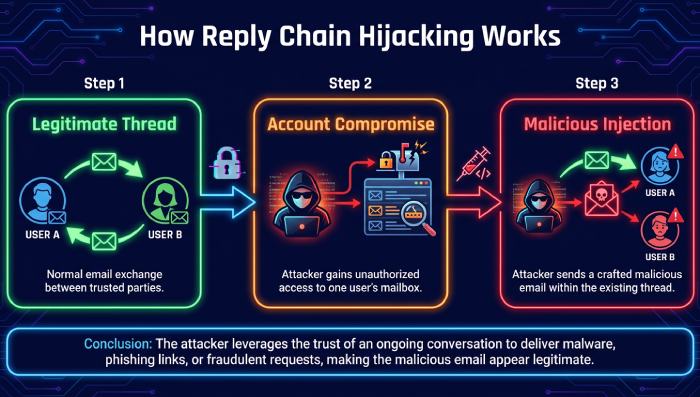
A reply chain attack occurs when attackers insert themselves into an existing email conversation and continue the discussion as if they are a legitimate participant. This technique is also known as thread hijacking, email thread hijacking, or conversation hijacking. Unlike ordinary phishing, which often starts with a cold message, a reply-chain attack abuses a trusted email thread that already contains real participants, familiar context, and prior exchanges.
The Power of a Trusted Email Thread
A trusted email thread carries pre-built trust. Employees, vendors, clients, internal staff, trusted suppliers, and business partners may already recognize the subject line, names, email signature, and conversation history. Because the message appears to belong to an ongoing email conversation, recipients are less likely to scrutinize it.
This is why email thread hijacking is so effective. The attacker does not need to build credibility from scratch. The contextual relevance is already there: a contract discussion, a project update, a delivery issue, or a pending payment request. In many cases, visual cues such as previous replies, quoted text, and familiar formatting make the message look legitimate.
Why Traditional Phishing Defenses Struggle
Many security defenses are optimized to detect suspicious new messages, but thread hijacking creates security blind spots. A message inside a real trusted email thread may appear to come from a trusted sender, especially if the sender’s mailbox has suffered account compromise. This can lead to filter overconfidence, where organizations assume their gateways will catch every phishing attempt.
Human Trust Becomes the Attack Surface
A reply chain attack succeeds because people naturally trust continuity. When an email conversation looks familiar, employees may overlook small inconsistencies, such as a tone or language change, sudden urgency, or unusual instructions.
How Attackers Gain Access to Existing Email Threads
Attackers typically need access to real messages before they can launch a convincing reply-chain attack. This access often begins with account compromise, where a user’s mailbox is taken over through credential harvesting, malware, or credential theft.
Account Compromise and Mailbox Mining
Once an account compromise occurs, attackers search the compromised corporate email account for valuable threads. They look for invoices, contracts, shipping notices, wire transfer discussions, and vendor communications. This mailbox mining allows them to identify a trusted email thread with financial or operational value.
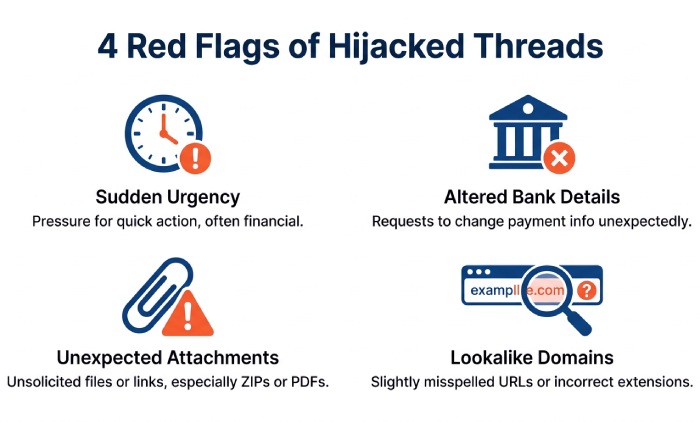
In a classic business email compromise scenario, attackers monitor the email conversation until the right moment, then inject a payment request, a fake invoice, or a request to change banking details. This form of conversation hijacking is particularly dangerous because the attacker’s message may come from the real account of an employee, vendor, or executive.
Spoofing, Lookalike Domains, and Forwarded Threads
Not every email thread hijacking incident requires full mailbox access. Attackers may use spoofing, a lookalike domain, or a forwarded thread to create the appearance of continuity. For example, a legitimate domain such as vendor-support.com may be imitated as vendor-supp0rt.com. This enables vendor impersonation without direct mailbox control.
Email Headers and Authentication Checks
Security teams should inspect email headers, sender paths, and domain-based authentication results such as SPF, DKIM, and DMARC. Tools like TDMARC can support this process, while secure messaging services such as RMail from RPost and insights from RPost Cybersecurity Insights on rpost.com may help organizations strengthen email integrity practices.
Common Tactics Used to Manipulate Trust and Urgency
A reply-chain attack is rarely random. Attackers use social engineering, timing, and contextual details to make the request feel normal. This is where thread hijacking becomes more persuasive than generic phishing.
Financial Manipulation and Business Email Compromise
In business email compromise, attackers often target finance teams, procurement staff, or executives. They may reply to an existing vendor thread with a fake invoice, altered bank details, or an urgent payment request. Because the message appears inside a trusted email thread, the recipient may process it quickly.
This type of reply-chain attack can also involve multiple participant risk. If several employees, vendors, and clients are included, one person’s assumption that “someone else verified it” can accelerate financial fraud.
Malware Delivery Through Familiar Conversations
Some attackers use email thread hijacking to deliver a malicious attachment or malicious link. Malware families such as Emotet have historically abused real email threads to spread malicious documents. A message may claim to include an updated purchase order, a contract revision, or a macro-enabled file related to an ongoing discussion.
Historic Thread Abuse
This historic thread abuse gives the message credibility. When attackers reuse old replies and internal language, the malicious content appears tied to legitimate work. A reply-chain attack may therefore bypass both technical controls and human skepticism.
Sudden Urgency and Contextual Pressure
Common warning signs include sudden urgency, unexpected payment changes, unexpected attachments, and subtle changes in tone. A trust decay checklist can help employees pause and verify whether the email conversation still deserves the same level of trust.
Business Risks: Fraud, Malware, Data Theft, and Reputational Damage
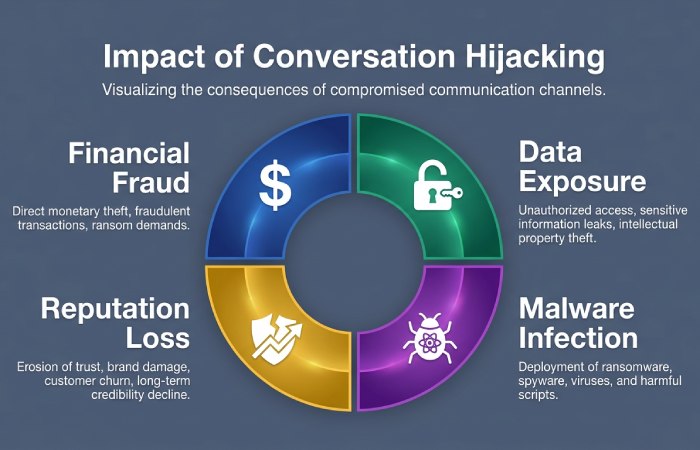
The impact of conversation hijacking extends far beyond a single message. Organizations may face monetary loss, malware infection, data exposure, and loss of confidence among clients and business partners.
Fraud and Data Exposure
The most visible risk is financial fraud through business email compromise. A single successful reply-chain attack can redirect funds, expose supplier data, or compromise sensitive negotiations. If the attacker uses the thread for credential harvesting, the incident may lead to wider account compromise across Microsoft 365, Google Workspace, or other cloud services.
Another risk is data theft. Attackers may ask for employee records, tax forms, project files, or client documents under the cover of an ongoing email conversation. Because conversation hijacking appears operationally relevant, employees may comply without escalation.
Malware and Reputational Harm
A malicious attachment or malicious link sent through a real thread can infect multiple recipients. If the message reaches trusted suppliers or clients, the organization’s reputation suffers. Customers may question whether the company can protect communications, and business partners may hesitate to continue sensitive collaboration.
CISA has repeatedly warned that email-based social engineering remains a major threat, particularly when attackers blend technical compromise with believable business context. A determined phishing group can turn one compromised mailbox into a chain of thread hijacking attempts across vendors, employees, and external partners.
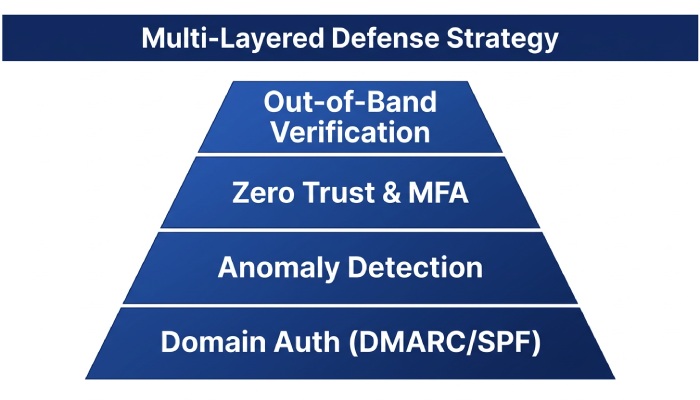
How to Detect, Prevent, and Respond to Reply Chain Hijacking
Defending against email thread hijacking requires a mix of technology, process, and people-centric vigilance. No single tool eliminates the risk, because a reply-chain attack exploits both identity and trust.
Detection Through Anomaly Detection and Verification
Security teams should use anomaly detection to identify unusual sending behavior, login locations, forwarding rules, and impossible travel events. A message inside a familiar thread should still be checked when it includes bank changes, new attachments, urgent instructions, or unusual recipients.
Employees should verify sensitive requests through a separate channel, especially when a business email compromise pattern appears. Calling a known number, confirming through a vendor portal, or validating with an internal approver can stop a reply-chain attack before money or data leaves the organization.
Practical Signals to Review
Look for altered sender domains, mismatched reply-to addresses, broken formatting, strange email signature details, or a sudden shift in writing style. These signs often reveal conversation hijacking even when the surrounding thread is legitimate.
Prevention Through Training, Controls, and Zero Trust
A zero trust mindset should apply to email threads: trust is never permanent. Even a trusted email thread can become unsafe after account compromise. Strong MFA, conditional access, mailbox rule monitoring, and domain authentication reduce exposure.
Organizations should also invest in user awareness, simulation training, and clear procedures for reporting suspicious messages. Platforms such as Threatcop Security Awareness Training, TSAT, Threatcop Learning Management System, TLMS, and Threatcop Phishing Incident Response, or TPIR, support structured People Security Management programs. Threatcop and cybersecurity expert Praveen Pal Singh have emphasized the importance of addressing human risk across regions such as North India & ASEAN; resources at threatcop.com may help teams mature these practices.
For broader controls, organizations can evaluate secure email gateways, incident response workflows, DMARC monitoring, and phishing protection capabilities that reduce exposure to phishing and account takeover.
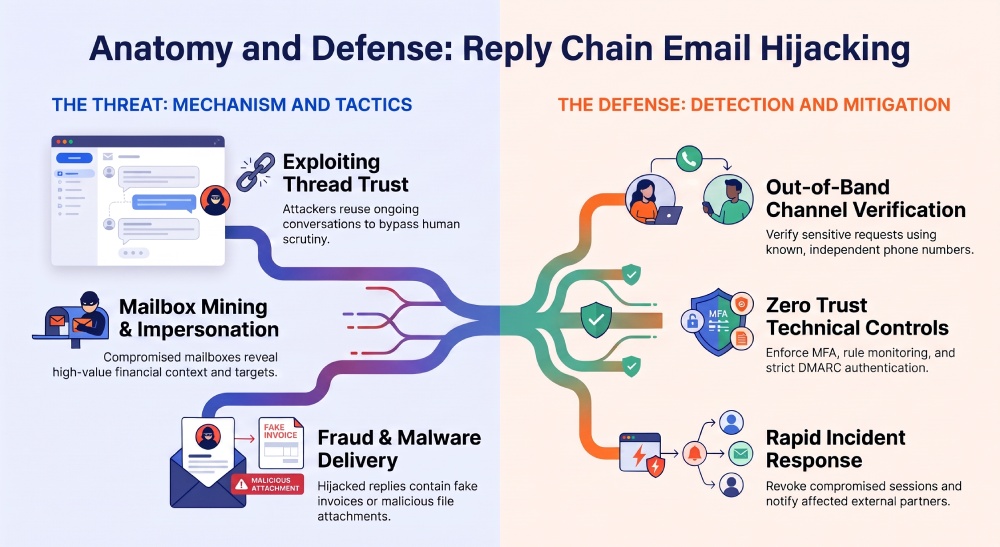
Response After a Suspected Reply-Chain Attack
When a reply-chain attack is suspected, immediately preserve evidence, analyze headers, disable compromised accounts, revoke sessions, reset credentials, and review mailbox forwarding rules. Notify affected clients, vendors, and internal staff if the email thread hijacking reached external parties.
Containment should also include searching for related reply-chain attack messages, checking for additional account compromise, and reviewing whether similar conversation hijacking attempts targeted other employees. A disciplined response limits damage from phishing, business email compromise, and future thread hijacking attempts.
General Manager
General Manager of DuoCircle. Product strategy and commercial lead across DuoCircle's 2,000+ customer base.
LinkedIn Profile →Protect your inbox from phishing attacks
Real-time email security with 60-day free trial. No credit card required.