CEO Impersonation: How Attackers Trick Employees Into Taking Action

Quick Answer
CEO impersonation is a social engineering attack where criminals pretend to be company executives to pressure employees into transferring funds, revealing sensitive information, changing payment details, or taking other unauthorized actions.
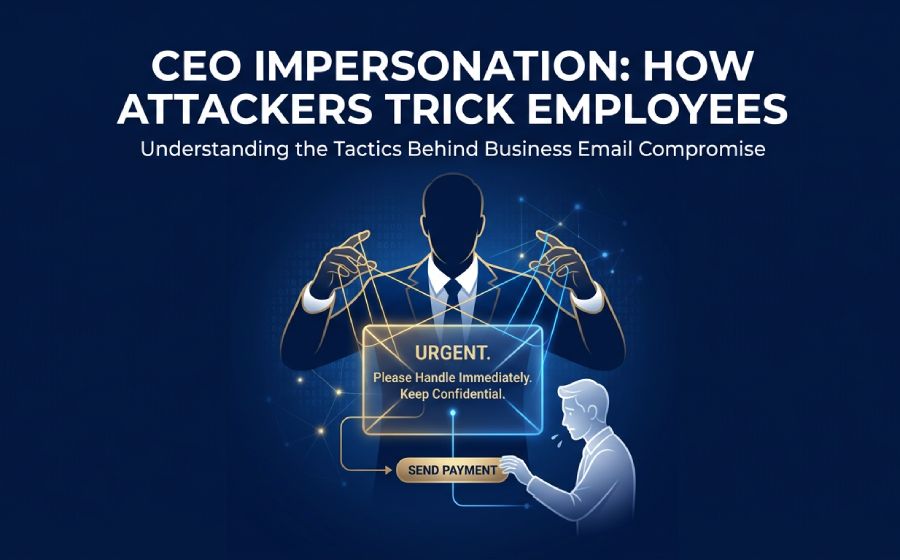
CEO impersonation is a targeted form of cybercrime in which attackers pretend to be a CEO, CFO, or another high-level executive to pressure an employee into taking action. It is a major form of Business Email Compromise, commonly abbreviated as BEC, and is closely related to CEO fraud, executive impersonation, Whale phishing, and whaling.
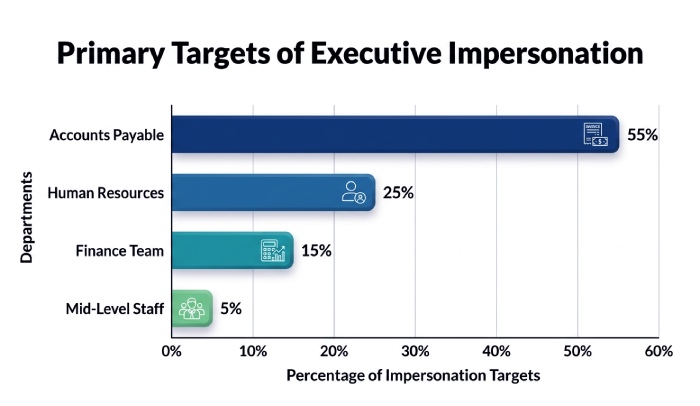
Unlike broad email scams sent to thousands of recipients, CEO impersonation usually relies on spear-phishing. The phishing email is crafted for a specific recipient, often someone in the Accounts Payable Department, Human Resources Department, finance team, or mid-level staff role with access to payments, payroll information, tax information, credentials, or sensitive data.
Why Employees Fall for CEO Fraud
CEO fraud works because it exploits normal workplace behavior. Employees are conditioned to respond quickly to C-level executives, especially when a message appears to come from the CEO or CFO. A realistic phishing email may include an urgent request, a secrecy request, and language about confidentiality, making the recipient feel they must act before verifying.
This is why Business Email Compromise remains one of the most damaging forms of financial fraud. The FBI has repeatedly warned that BEC and CEO fraud cause billions in losses globally, often through wire transfer fraud, unauthorized funds transfer, credentials theft, and sensitive data exposure.
CEO Impersonation as a Corporate Email Threat
CEO impersonation is not just a phishing problem; it is a corporate email threat that combines social engineering, email spoofing, information gathering, and employee deception. In many targeted attacks, the message is short, polite, and believable:
“I’m in a meeting and need this handled immediately. Please keep this confidential.”
That single urgent request, paired with confidentiality and a secrecy request, can override normal security behavior if employees have not received strong security awareness training.
Common Scenarios: Wire Transfers, Gift Cards, Payroll Changes, and Data Requests
Wire Transfer Fraud and Urgent Financial Requests
The most damaging CEO impersonation scenario is wire transfer fraud. In this version of CEO fraud, attackers send a phishing email that appears to come from a CEO, CFO, or another high-level executive. The message instructs the Accounts Payable Department to process urgent financial requests, often to support an acquisition, legal settlement, vendor payment, or overseas transaction.
The attacker may write that the matter is under strict confidentiality and include a secrecy request such as “do not discuss this with anyone yet.” This is classic Business Email Compromise: the BEC message creates pressure, isolates the employee, and pushes an unauthorized funds transfer before sender verification occurs.
Fraud Indicators in Payment Requests
Common fraud indicators include a mismatched sender, a spoofed email address, a newly changed bank account, unusual timing, and an immediate action request. Strong email security, BEC protection, phishing protection, and incident response processes help prevent CEO fraud before money leaves the organization.
Gift Card and Procurement Email Scams
Another common CEO impersonation technique is the gift card scam. The attacker sends a realistic email claiming to be a CEO or C-level executive who needs gift cards for clients or employees. While the dollar amounts are often smaller than wire transfer fraud, these email scams are effective because they feel informal and urgent.
This type of executive impersonation still depends on social engineering: an urgent request, a secrecy request, and an appeal to authority. The employee believes they are helping a high-level executive, when in fact they are becoming one of the victims of CEO fraud.
Payroll Changes, Tax Information, and HR Data Requests
The Human Resources Department is frequently targeted through spear-phishing and C-level executive impersonation. Attackers may request payroll information, employee W-2 forms, bank account updates, direct deposit changes, or tax information. These attacks expose sensitive data and create data protection, compliance, and insider risk concerns.
A phishing email may claim: “Please send the updated employee tax file before close of business. This is confidential.” Again, confidentiality, urgency, and a secrecy request are used together to make the recipient bypass normal controls.
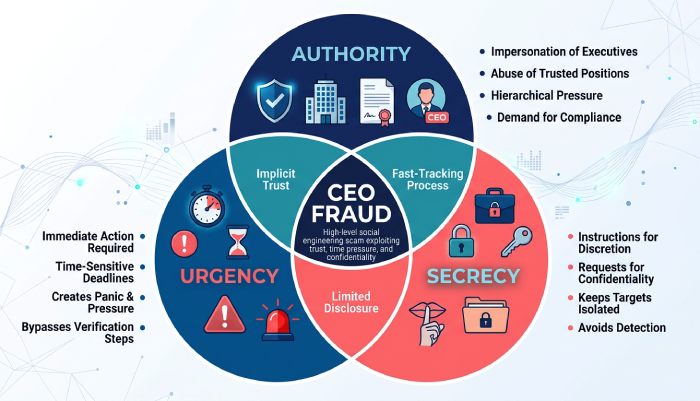
The Psychology Behind the Scam: Authority, Urgency, Secrecy, and Trust
Authority: “The CEO Asked Me”
CEO impersonation succeeds because authority is powerful. When an instruction seems to come from the CEO, CFO, or C-level executives, employees may comply quickly. This is why C-level executive impersonation is often more effective than generic phishing. Attackers understand that employee deception works best when the sender appears senior, busy, and important.
This makes executive impersonation a high-risk form of social engineering. The employee is not tricked by malware alone; they are manipulated by workplace hierarchy.
Urgency: The Immediate Action Request
Nearly every CEO fraud message includes an urgent request. The phishing email may say the executive is boarding a flight, entering a meeting, closing a deal, or dealing with regulators such as the FCA (Financial Conduct Authority). The goal is to reduce thinking time.
Urgency is central to BEC. Whether the request involves wire transfer fraud, sensitive data, or credentials theft, the attacker wants immediate action before the recipient checks with another person.
Secrecy and Confidentiality
A secrecy request is one of the strongest signs of CEO impersonation. Attackers may write, “Do not loop anyone else in,” “This must remain confidential,” or “Maintain confidentiality until I say otherwise.” These phrases are designed to block normal verification.
Why Secrecy Requests Are Dangerous
A secrecy request turns a business process into a private exchange. That increases insider risk, weakens risk management, and prevents reporting scams to the security team. Any message combining confidentiality, an urgent request, and financial or sensitive data instructions should be treated as a potential Business Email Compromise attempt.
Trust and Familiarity
Modern spear-phishing messages often reference real projects, colleagues, vendors, or travel schedules. These realistic emails build trust by sounding like internal communication. Attackers may imitate tone, formatting, signatures, and even Microsoft 365 email threads after an account takeover.
This is why email threat protection must address both technical indicators and human behavior. Security tools can identify suspicious domains, but security awareness training and Security Behavior Management help employees recognize social engineering patterns.
How Attackers Research Companies and Choose Their Targets
Information Gathering and Company Website Research
Before launching CEO impersonation, attackers conduct information gathering. Company website research reveals leadership names, office locations, press releases, investor updates, vendor relationships, and executive biographies. A CEO Fraud attempt may be timed around mergers, earnings announcements, events, or leadership travel.
Attackers study who approves payments, who manages payroll information, and who handles sensitive data. This reconnaissance supports targeted attacks and makes the resulting phishing email more believable.
Social Media Reconnaissance on LinkedIn, Facebook, and Twitter
Social media reconnaissance is also common. LinkedIn reveals job titles, reporting lines, new hires, and members of the Accounts Payable Department or Human Resources Department. Facebook and Twitter can expose travel, events, relationships, and organizational changes.
This open-source intelligence allows attackers to personalize spear-phishing messages. For example, a BEC email may reference a real vendor, a recent conference, or a CFO’s public post. The more context the attacker has, the more convincing the CEO impersonation becomes.
Choosing Victims Inside the Organization
Victims are often employees who can move money, update payroll, share tax information, or access sensitive data. Mid-level staff are frequent targets because they may have operational access without the authority to challenge a high-level executive. In C-level executive impersonation, the attacker exploits the gap between authority and verification.
Threat intelligence from sources such as the Mimecast Threat Intelligence Hub, Cyber Insights Blog, Mimecast Knowledge Hub, Mimecast Newsroom, Mimecast Events, Mimecast Awards, Mimecast Customer Stories, and broader cybersecurity reporting shows that attackers continuously refine their methods. AI-Powered Security and Agentic AI Security are increasingly important as attackers generate more realistic emails at scale.
Email Spoofing, Lookalike Domains, and Compromised Accounts
Email Spoofing and Spoofed Email Addresses
Email spoofing is one of the most common techniques in CEO impersonation. The attacker sends a phishing email that appears to come from the CEO, but the sender address may include a mismatched sender, altered display name, or spoofed email address. Without strong sender verification, the recipient may see only the executive’s name and assume the message is legitimate.
DNS authentication and email authentication controls such as SPF, DKIM, and DMARC reduce spoofing risk. Tools like DMARC Analyzer can help organizations monitor domain abuse, strengthen brand protection, and improve attack prevention.
Lookalike Domains and BEC Defense
Lookalike domains are another core BEC tactic. Attackers register domains that resemble the company’s real domain, replacing letters or adding small variations. These domains support CEO fraud, executive impersonation, and wire transfer fraud by making the phishing email look authentic.
BEC Defense requires layered email security. Mimecast capabilities such as Advanced Email Security, Impersonation Protect, Managed Threat Response, Email Archive, and email threat protection can help detect suspicious sender behavior, malicious links, and corporate email threat patterns.
Compromised Accounts and Account Takeover
In some Business Email Compromise cases, the attacker does not spoof the CEO at all. Instead, they use account takeover to send emails from a legitimate mailbox. This makes C-level executive impersonation harder to detect because the message may pass basic email authentication.
Account takeover can lead to CEO impersonation, CEO fraud, credential theft, insider threats, and sensitive data loss. Solutions such as Incydr, Insider Risk Management, Aware Governance & Compliance Suite, and Security Behavior Management can support data protection, compliance, and incident response when suspicious internal activity appears.
Building Human and Technical Defenses
Organizations should combine phishing protection, BEC protection, sender verification, and security awareness training to prevent CEO fraud. Mimecast Engage Awareness Training, Engage Security Awareness, Security Awareness Training, BEC Defense resources, Mimecast Partner Services Program, Mimecast Reseller Partners, and SpringLaunch-style enablement can help organizations improve reporting scams, reinforce security behavior, and reduce successful employee deception.
Red Flags Employees Should Watch For in CEO Impersonation Attempts
Unusual Urgency, Pressure, and Secrecy
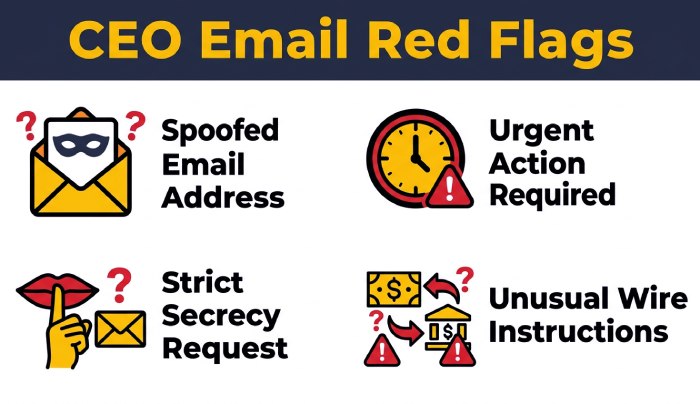
A classic CEO impersonation attempt often starts with an urgent request that appears to come from the CEO, CFO, or another high-level executive. The message may demand an immediate action request such as “process this payment today,” “send employee files now,” or “do not discuss this with anyone.” That combination of urgency, confidentiality, and a secrecy request is one of the strongest fraud indicators in CEO fraud and Business Email Compromise.
Attackers use social engineering to make the recipient feel they are helping leadership during a sensitive matter. In many BEC attacks, the phishing email claims the executive is in a meeting, traveling, or unavailable by phone. This is designed to prevent sender verification and keep the employee isolated.
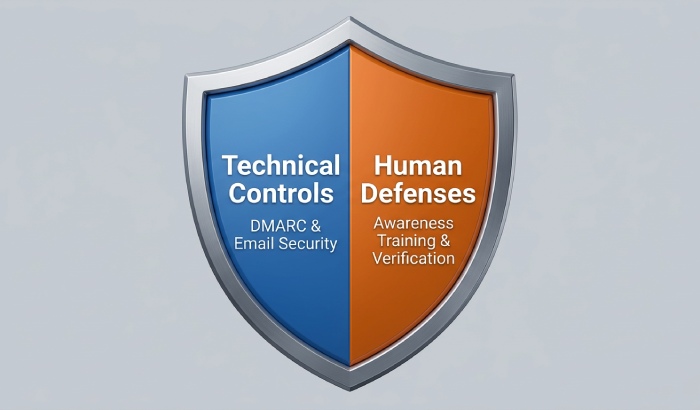
Suspicious Sender Details and Email Spoofing
Employees should look closely for a mismatched sender, spoofed email address, or slight domain variation. In executive impersonation, attackers often register lookalike domains or exploit email spoofing to make realistic emails appear legitimate. A message that displays the CEO’s name but comes from an external or unfamiliar address should be treated as a corporate email threat.
DNS authentication controls such as SPF, DKIM, and DMARC help reduce spoofing, while tools like DMARC Analyzer and Mimecast Advanced Email Security can strengthen email authentication and brand protection. Still, technical controls do not replace human judgment when a phishing email includes a secrecy request, urgent request, or request for sensitive data.
Requests for Money, Credentials, or Sensitive Data
CEO fraud frequently targets the accounts payable department, finance teams, and mid-level staff who can initiate payments. Common lures include urgent financial requests, invoice changes, vendor payment instructions, or wire transfer fraud. A sudden request for an unauthorized funds transfer should always trigger additional verification.
The human resources department is also a frequent target. Attackers may request payroll information, tax information, W-2 records, employee bank details, or other sensitive data. These email scams may also lead to credential theft by directing employees to fake Microsoft login pages, account takeover portals, or cloud document links.
Real-World Consequences for Businesses and Employees
Financial Loss, Regulatory Exposure, and Operational Disruption
The FBI has repeatedly warned that Business Email Compromise and BEC schemes cause billions in global losses. A single successful CEO impersonation attack can result in wire transfer fraud, financial fraud, data protection failures, and major incident response costs. Once funds leave the organization, recovery can be difficult, especially when attackers move money through mule accounts or overseas banks.
Victims may also face compliance consequences if sensitive data, payroll information, or tax information is exposed. Regulators such as the FCA, or Financial Conduct Authority, expect organizations to maintain appropriate cybersecurity, risk management, and email security controls. Failure to prevent CEO fraud can damage customer confidence, investor trust, and internal morale.
Personal Impact on Employees
Employees caught in CEO fraud are often victims of carefully planned social engineering, not careless insiders. Attackers conduct information gathering, company website research, and social media reconnaissance across LinkedIn, Facebook, and Twitter to craft targeted attacks that feel authentic. This employee deception is especially effective when the phishing email appears to come from C-level executives.
However, the consequences can still be severe. An employee may feel responsible for wire transfer fraud, a sensitive data breach, or an account takeover. Organizations should avoid a blame-first culture and instead focus on reporting scams, improving security behavior, and strengthening BEC protection.
Why C-Level Executive Impersonation Works
C-level executive impersonation works because employees are conditioned to respond quickly to leadership. A high-level executive asking for confidentiality can override normal caution, especially if the message includes a secrecy request tied to a merger, acquisition, legal matter, or vendor deadline.
This is why Whale Phishing, also known as whaling, is so dangerous. Whale phishing targets senior leaders directly, while executive impersonation uses the identity of those leaders to manipulate others. In both cases, spear-phishing and social engineering turn authority into a weapon.
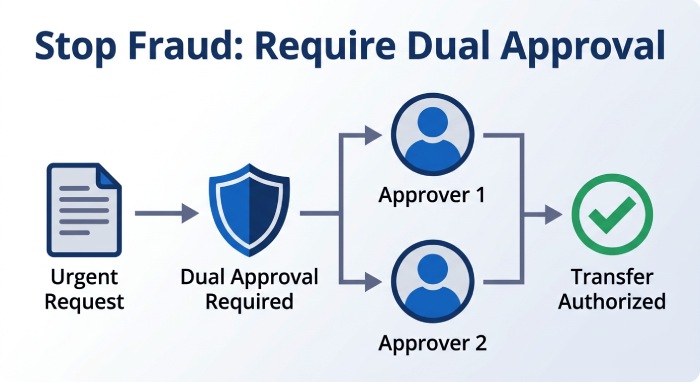
Verification Procedures That Stop Fraud Before Money or Data Is Lost
Establish Out-of-Band Verification
Every urgent request involving money, credentials, or sensitive data should require out-of-band sender verification. Employees should call a known phone number, use an approved internal messaging platform, or verify through a secondary authorized contact. They should never reply directly to the suspicious phishing email or use contact details included in the message.
For example, if the CFO appears to request a wire transfer or fraud-prone payment, the Accounts Payable Department should confirm through a documented callback procedure. If the CEO requests payroll information or tax information, the Human Resources Department should validate the request through an approved HR workflow.
Require Dual Approval for High-Risk Actions
Organizations can prevent CEO fraud by requiring dual approval for urgent financial requests, vendor bank changes, and sensitive data transfers. Any urgent request with confidentiality language or a secrecy request should be escalated, not accelerated.
Strong controls include:
- Dual authorization for wire transfers and invoice changes
- Mandatory verification for new vendor payment instructions
- Access controls for payroll information and tax information
- Audit trails through Email Archive and finance systems
- Escalation paths for suspected Business Email Compromise
These procedures reduce the chance that BEC becomes an unauthorized funds transfer.
Create Clear Reporting Channels
Employees need simple ways to report CEO impersonation, phishing email attempts, and email scams. A dedicated phishing-report button, security mailbox, or hotline can help the security team respond quickly. Reporting scams early can stop targeted attacks before other victims receive similar messages.
Incident response teams should preserve headers, attachments, sender details, and timestamps. Threat intelligence from platforms such as Mimecast Threat Intelligence Hub, Managed Threat Response, and Microsoft security logs can help determine whether the attack involved email spoofing, account takeover, or broader cybercrime activity.
Security Awareness Training and Simulated Phishing Exercises
Training Must Reflect Real CEO Fraud Scenarios
Security awareness training should teach employees how CEO fraud, BEC, spear-phishing, and executive impersonation actually look in day-to-day work. Generic warnings are not enough. Training should include realistic emails that imitate C-level executive impersonation, urgent request language, confidentiality pressure, and secrecy request tactics.
Programs such as Mimecast Engage Awareness Training and Engage Security Awareness can reinforce phishing protection through short, practical modules. Security Awareness Training should also cover sensitive data handling, credential theft, insider risk, and the difference between a legitimate business request and a suspicious phishing email.
Simulations Build Better Security Behavior
Simulated spear-phishing exercises help employees practice recognizing fraud indicators before a real attacker contacts them. These exercises should test email scams involving vendor payments, wire transfer fraud, payroll information, tax information, and account takeover attempts.
Well-designed simulations improve security behavior by helping users pause, verify, and report. Over time, metrics from Security Behavior Management, Aware Governance & Compliance Suite, and Insider Risk Management can show which departments need additional coaching.
Make Training Role-Specific
Different teams face different risks. The accounts payable department needs deeper training on wire transfer fraud, urgent financial requests, and BEC protection. The human resources department needs scenarios involving sensitive data, payroll information, tax information, and confidentiality lures.
Executives also need training. CEOs, CFOs, and C-level executives are central to both Whale Phishing and C-level executive impersonation schemes. They should understand how attackers use LinkedIn, Facebook, Twitter, company website research, and public announcements to make social engineering more believable.
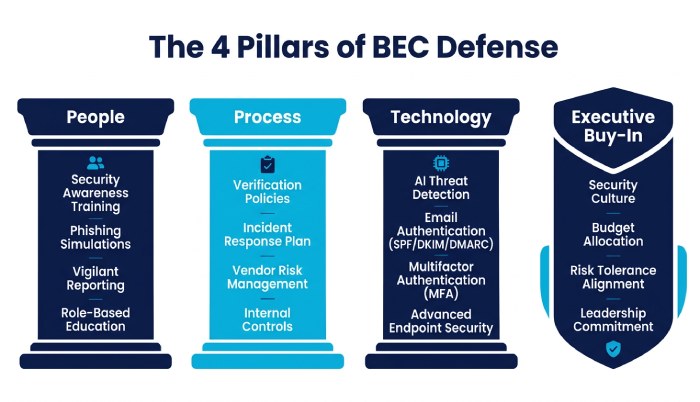
Building a Companywide Defense: Policies, Tools, and Executive Buy-In
Combine People, Process, and Technology
A mature defense against CEO impersonation requires more than a spam filter. Organizations need clear policies, security tools, email security controls, and executive buy-in. Mimecast solutions such as Advanced Email Security, Impersonation Protect, DMARC Analyzer, Threat Intelligence Hub, Managed Threat Response, and Email Archive can support layered email threat protection and attack prevention.
AI-Powered Security, Agentic AI Security, and threat intelligence can help identify suspicious language, spoofed email address patterns, anomalous senders, and realistic emails designed for employee deception. These capabilities are especially important as attackers use automation and generative tools to scale Business Email Compromise.
Align Policies With Risk Management and Compliance
Policies should define how employees handle urgent request messages, confidentiality claims, sensitive data transfers, and secrecy request scenarios. They should also specify who can approve payments, how sender verification is performed, and when incident response is activated.
Risk management and compliance teams should work with cybersecurity leaders to document BEC Defense practices. This includes phishing protection, data protection, insider threat monitoring, email authentication, and escalation workflows. Solutions such as Incydr may support insider risk visibility, while Mimecast’s Aware Governance & Compliance Suite can help identify risky communications and policy violations.
Executive Buy-In Sets the Tone
Executive support is essential to prevent CEO fraud. If employees believe leadership values speed over verification, attackers will exploit that culture. CEOs, CFOs, and other C-level executives should clearly state that no employee will be punished for slowing down an urgent request to verify legitimacy.
Executive messaging should reinforce that confidentiality does not mean bypassing controls. A secrecy request from a supposed high-level executive should be treated as a reason to verify, not a reason to hide the transaction.
Use Vendor Ecosystems and Ongoing Intelligence
Organizations can strengthen BEC protection by staying informed through resources such as the Mimecast Cyber Insights Blog, Mimecast Knowledge Hub, Mimecast Newsroom, Mimecast Events, Mimecast Awards, Mimecast Customer Stories, and SpringLaunch announcements. The Mimecast Partner Services Program and Mimecast Reseller Partners can also help organizations deploy, tune, and mature email threat protection.
Broader business initiatives, including ESG & Global Impact programs, should recognize cybersecurity as part of operational resilience. CEO Fraud, Business Email Compromise, and executive impersonation are not only IT issues; they are enterprise risks that affect finance, legal, HR, compliance, and brand protection.
FAQs
What is the biggest red flag in a CEO impersonation email?
The biggest red flag is an urgent request combined with confidentiality or a secrecy request. If a message pressures an employee to bypass normal approval steps, send sensitive data, or process a payment immediately, it should be treated as a potential CEO fraud or BEC attempt.
How is CEO fraud different from regular phishing?
Regular phishing often targets many users with broad email scams, while CEO fraud is usually a targeted spear-phishing or social engineering attack. CEO impersonation uses the authority of a CEO, CFO, or other high-level executive to manipulate employees into wire transfer fraud, credential theft, or sensitive data disclosure.
Which departments are most at risk from Business Email Compromise?
The accounts payable department and human resources department are common targets because they handle payments, payroll information, tax information, and employee records. Executives and finance teams are also frequent victims of BEC, whaling, and C-level executive impersonation.
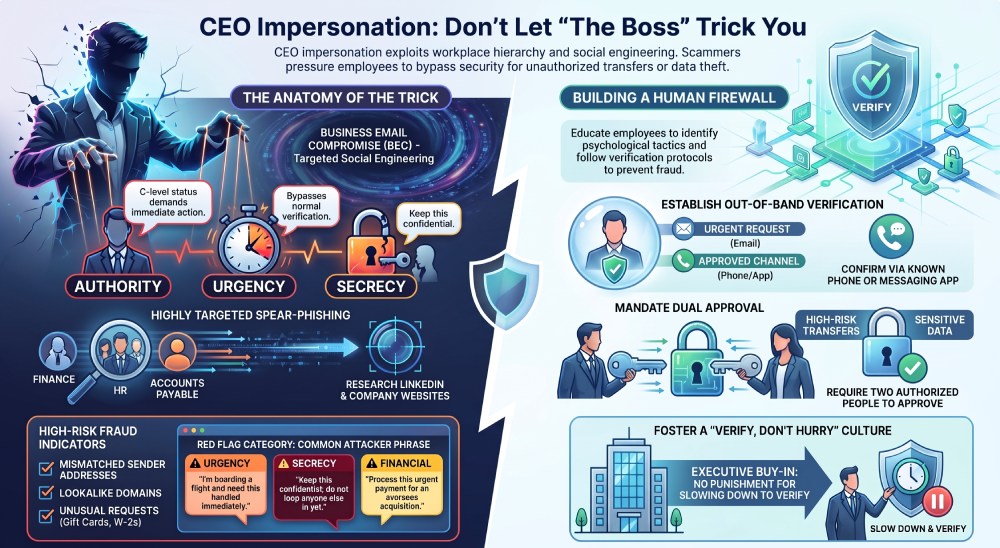
How can employees verify a suspicious executive request?
Employees should use out-of-band sender verification, such as calling a known phone number or confirming through an approved internal channel. They should not use phone numbers, links, or instructions included in the suspicious phishing email.
Can email security tools stop CEO impersonation completely?
Email security tools can significantly reduce CEO impersonation, email spoofing, and Business Email Compromise risk, but they cannot eliminate every attack. The strongest defense combines email authentication, threat intelligence, phishing protection, security awareness training, and clear approval policies.
What should an employee do after clicking a suspicious link?
The employee should report the incident immediately to the security or IT team and avoid entering any credentials. Fast reporting helps incident response teams investigate account takeover risk, block malicious domains, and protect other recipients.
Key Takeaways
- CEO impersonation often relies on urgency, confidentiality, and a secrecy request to pressure employees into unsafe action.
- Business Email Compromise (BEC) and spear-phishing can lead to wire transfer fraud, sensitive data exposure, and regulatory consequences.
- Verification procedures, dual approval, and clear reporting channels are essential to prevent CEO fraud.
- Security awareness training and simulated phishing exercises help employees recognize executive impersonation and social engineering.
- Strong defense requires executive buy-in, email security tools, email authentication, threat intelligence, and companywide risk management.
General Manager
General Manager of DuoCircle. Product strategy and commercial lead across DuoCircle's 2,000+ customer base.
LinkedIn Profile →Protect your inbox from phishing attacks
Real-time email security with 60-day free trial. No credit card required.