Measuring ROI From Phishing Simulation Training Programs

Quick Answer
Measuring ROI from phishing simulation training programs involves tracking reductions in phishing click rates, security incidents, and remediation costs while assessing improvements in employee awareness. A positive ROI is achieved when training lowers cyber risks and prevents costly breaches.
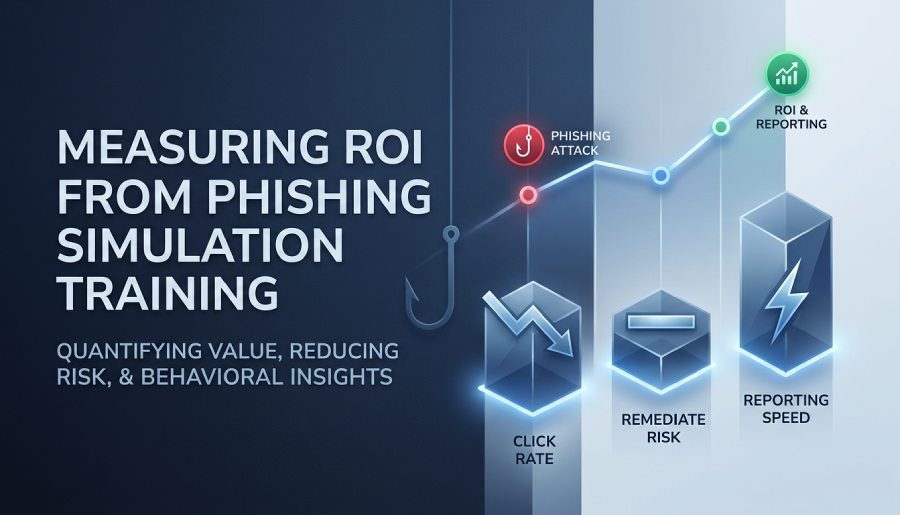
Phishing simulation training is often treated as a compliance exercise, but its real value is as a measurable risk-reduction tool. A well-designed training program helps organizations understand how employees respond to a phishing attack, how quickly they report suspicious messages, and whether security awareness training is creating durable behavioral changes. ROI matters because executives need to see that employee training is not just “checking a box”—it is reducing phishing risk, improving detection, and strengthening the organization’s secure posture.
When teams simulate a phishing attack, they create a controlled environment for measuring user behavior before a real attacker exploits it. This makes phishing simulation training especially valuable for phishing risk mitigation and risk management. Instead of relying only on technical controls, organizations can combine phishing protection, threat protection, and user awareness, giving security leaders a clearer view of human-layer exposure.
ROI Turns Awareness Into Business Evidence
A phishing attack can lead to credential theft, ransomware, data security incidents, unauthorized network access, regulatory compliance issues, and business interruption. Measuring ROI connects security awareness training to business outcomes such as avoided breach costs, reduced incident response time, and fewer high-risk user actions.
For example, Microsoft Security tools such as Microsoft Defender, Microsoft Sentinel, Microsoft Entra, Microsoft Intune, and Microsoft Purview can help organizations correlate attack simulation training results with identity protection, endpoint signals, investigation workflows, and compliance obligations across Microsoft 365, Office 365, Azure, Dynamics 365, Microsoft Teams, Windows 365, and the broader Microsoft Cloud. This broader context turns phishing simulation from an isolated exercise into a strategic risk-reduction tool.
Key Metrics to Track: Click Rates, Reporting Rates, and Repeat Offenders
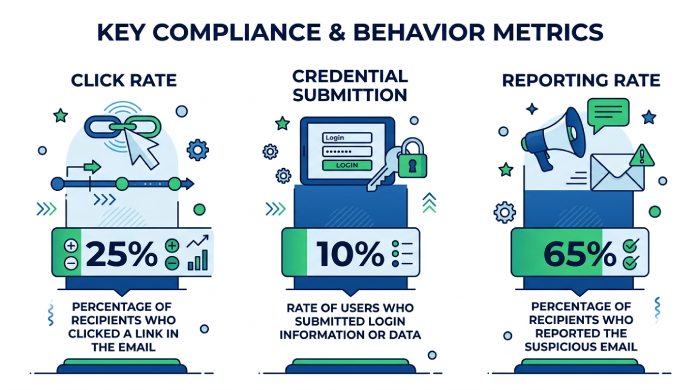
The most useful ROI model starts with consistent metrics. Phishing simulation training should measure not only who clicked, but also who reported, who submitted credentials, who ignored the message, and who repeatedly engaged with social engineering lures. These indicators reveal user behavior patterns and help security teams remediate risk with targeted employee training.
Click Rates and Credential Submission Rates
Click rate remains a foundational metric because it shows how many users engaged with a simulated phishing attack. However, the metric is more meaningful when segmented by department, geography, role, and access level. A finance employee clicking a payroll-themed phishing attack may represent a different phishing risk than a general employee clicking a low-impact newsletter lure.
Credential submission rate is even more important. If users enter passwords after you simulate a phishing attack, the organization may face elevated identity protection and network access risk. This should trigger targeted remediation, such as additional security awareness training, conditional access review, or Microsoft Entra policy evaluation.
Reporting Rates and Speed of Reporting
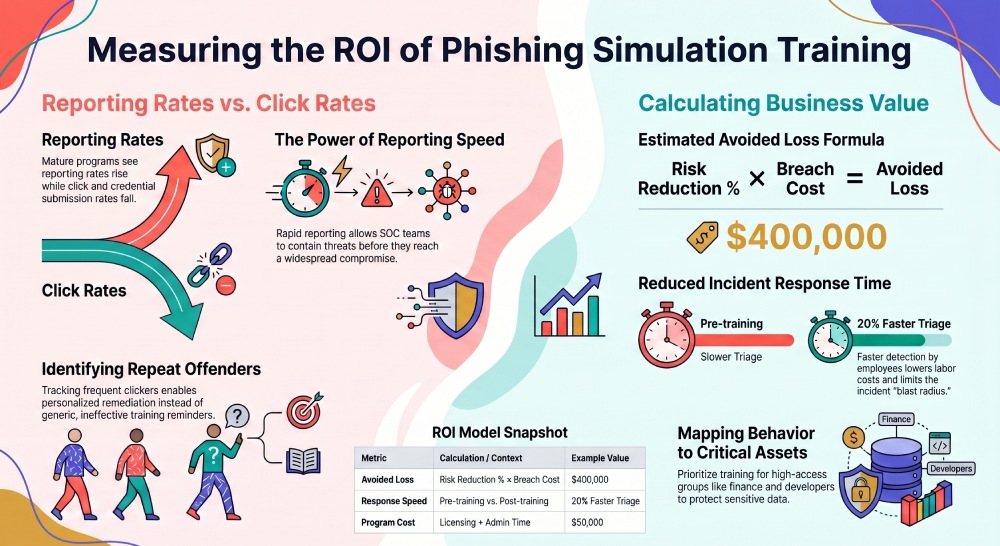
Reporting rate measures how many users identify and escalate a suspicious email. Strong reporting behavior improves detection and response because security teams can investigate threats faster. In mature programs, the reporting rate should rise while the click rate falls.
Reporting speed is also valuable. If employees report a phishing attack within minutes, the security operations center can block URLs, remove messages, initiate threat management workflows, and contain risk before widespread compromise. Tools such as Microsoft Defender for Office 365, Microsoft Sentinel, and Microsoft Security Copilot can enrich reporting and analytics with security insights that support faster investigation and response.
Repeat Offenders and High-Risk Groups
Repeat offenders are users who continue clicking, downloading, or submitting credentials across multiple campaigns. They are not necessarily careless; they may face high message volume, unclear processes, or sophisticated social engineering tactics. Tracking repeat offenders allows organizations to apply risk remediation through personalized employee training rather than broad, generic reminders.
Establishing a Phishing Baseline
A phishing baseline is the starting point for progress evaluation. Before launching a major security awareness training initiative, run an initial phishing assessment to understand current risk awareness and user behavior. This baseline becomes the reference point for measuring training evaluation, evaluation reporting, and long-term ROI.
Segmenting Results for Better User Risk Evaluation
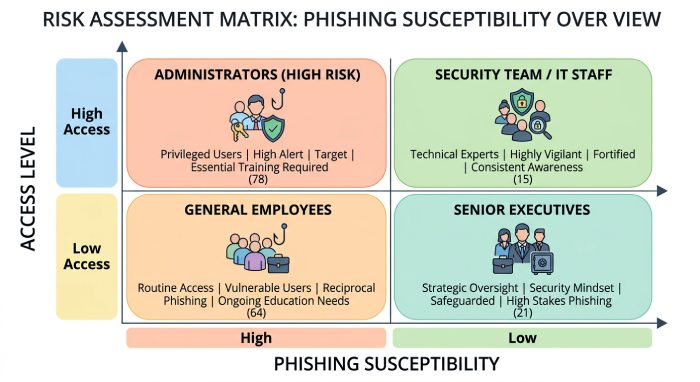
Segment metrics by privileged users, executives, help desk staff, developers, finance teams, and customer-facing employees. User risk evaluation is more accurate when the organization recognizes that not all users carry the same business risk.
Calculating Financial Impact: Avoided Breach Costs and Reduced Incident Response Time
The financial impact of phishing simulation training is calculated by estimating the cost of incidents avoided and the operational savings created by faster detection, prevention, remediation, and response. A practical ROI model compares program costs—platform licensing, technical content, training & certifications, administration time, and communications—against quantifiable risk reduction.
Avoided Breach Costs
A successful phishing attack can cause direct and indirect losses: forensic investigation, legal fees, customer notification, downtime, ransomware recovery, regulatory penalties, brand damage, and increased cyber insurance scrutiny. By reducing the probability of credential compromise or malware execution, attack simulation training can be modeled as a risk-reduction tool.
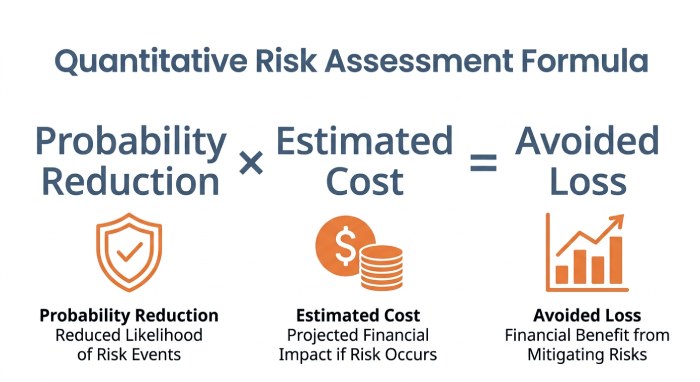
A simplified formula is:
Estimated avoided loss = breach probability reduction × estimated breach cost
For instance, if a phishing risk assessment shows that improved user awareness and security awareness training reduce the likelihood of a material phishing incident by 20%, and the estimated cost of a major phishing-related breach is $2 million, the avoided loss may be modeled at $400,000. This estimate becomes stronger when supported by reporting and analytics from phishing simulation training, Microsoft Defender, Microsoft Sentinel, and incident response records.
Reduced Incident Response Time
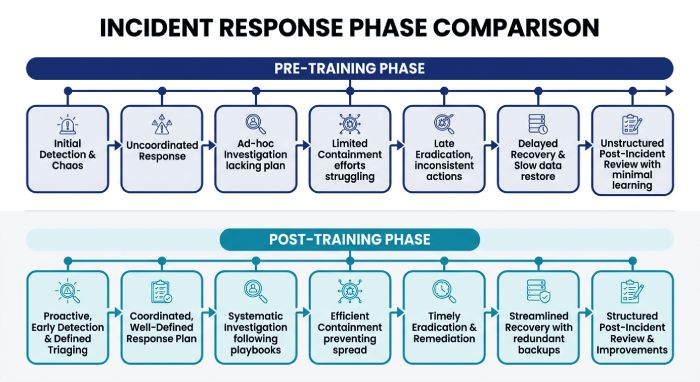
ROI also comes from operational efficiency. When users report suspicious emails quickly, security teams spend less time discovering threats and more time on containment. Reduced incident response time lowers labor costs and limits blast radius.
For example, if attack simulation training improves reporting rates, analysts can use Microsoft Defender for Office 365 to remove malicious messages, Microsoft Entra to address compromised identities, Microsoft Intune to manage affected devices, and Microsoft Purview to support data security and compliance workflows. Microsoft Security Copilot can further assist with summarization, triage, and security insights.
Linking Simulations to Real Incident Data
To calculate savings, compare pre-training and post-training metrics: average investigation time, number of users affected per phishing attack, time to containment, and volume of help desk tickets. These metrics demonstrate how phishing simulation training improves threat management and helps remediate risk faster.
Include Technology and Human-Layer Benefits
The strongest ROI models account for both technical controls and behavioral changes. Office 365 security features, Microsoft Defender policies, and intelligent simulation capabilities work best when users also understand social engineering tactics and report suspicious activity.
Connecting Training Results to Business Risk Reduction
Phishing simulation training should be integrated into the broader security strategy rather than managed as a standalone activity. The objective is not simply to simulate a phishing attack; it is to reduce phishing risk in ways that matter to the business.
Map User Behavior to Critical Assets
Connect user behavior results to business systems and sensitive data. For example, a high click rate among users with access to Dynamics 365 customer records, Azure administrative privileges, financial systems, or Microsoft Teams collaboration spaces may represent a higher business risk than the same click rate in a lower-access group.
This is where phishing risk mitigation becomes practical. Security teams can prioritize controls and employee training based on who has access to critical data, regulated workloads, or privileged accounts. Microsoft Entra, Microsoft Purview, Microsoft Intune, and Microsoft Defender can help align identity, device, data, and threat protection signals with phishing simulation outcomes.
Use External Benchmarks and Internal Evidence
Organizations can enrich internal reporting with external intelligence from the Microsoft Digital Defense Report, Microsoft Security Blog, Microsoft Tech Community, Microsoft Trust Center, Service Trust Portal, Security Response Center, Microsoft Research, and the Microsoft Secure Future Initiative. These sources help boards and executives understand why social engineering remains a persistent enterprise risk.
Terranova Security and Microsoft attack simulation training capabilities can also support intelligent simulation scenarios that reflect current adversary behavior. By aligning phishing assessment results with threat intelligence, organizations can show that the training program is responsive to real-world phishing attack patterns, not just generic awareness content.
Best Practices for Improving and Communicating ROI Over Time
ROI improves when phishing simulation training is continuous, adaptive, and tied to measurable business outcomes. A single annual phishing simulation is rarely enough to create lasting cybersecurity awareness. Effective programs simulate a phishing attack regularly, vary social engineering themes, and reinforce learning with timely security awareness training.
Build a Continuous Improvement Cycle
Use each campaign as a progress evaluation checkpoint. Start with a phishing baseline, identify risky user behavior, deliver targeted employee training, then retest. Over time, the organization should see fewer clicks, higher reporting rates, fewer repeat offenders, faster response, and stronger user awareness.
A mature cycle includes:
- Risk assessment: Identify departments, roles, and workflows most exposed to phishing risk.
- Prevention: Apply policy, filtering, and Office 365 security controls.
- Detection: Encourage rapid reporting and monitor suspicious activity.
- Remediation: Deliver focused training and adjust access where needed.
- Response: Improve incident response playbooks and analyst workflows.
Communicate ROI in Executive Terms
Executives usually do not need every technical detail; they need risk, cost, and trend clarity. Present phishing simulation training as a risk-reduction tool that supports compliance, data security, identity protection, and business resilience. Dashboards should include click rates, reporting rates, repeat offenders, avoided cost estimates, incident response improvements, and business-unit comparisons.
Microsoft Marketplace solutions, Microsoft Security integrations, the Compliance Program for Microsoft Cloud, Security Engineering Portal resources, Business Solutions Hub materials, and guidance from Microsoft Security can help teams mature reporting and analytics. Organizations using Microsoft Viva for communications or Microsoft Teams for security awareness campaigns can reinforce training content in the flow of work. Even specialized environments involving Windows 365 or Microsoft HoloLens should be considered when evaluating user access, device context, and phishing risk.
Make Training Relevant, Not Punitive
The best phishing simulation training programs avoid blame. Users should understand that a phishing attack is designed to manipulate attention, urgency, and trust. Training should explain social engineering patterns, provide practical reporting steps, and reinforce that employees are part of the organization’s defense model.
When attack simulation training is respectful and data-driven, employees are more likely to report suspicious messages, participate in employee training, and improve user behavior. That is where ROI becomes visible: fewer risky actions, faster detection, better remediation, stronger security awareness, and a measurable reduction in phishing risk over time.
General Manager
General Manager of DuoCircle. Product strategy and commercial lead across DuoCircle's 2,000+ customer base.
LinkedIn Profile →Protect your inbox from phishing attacks
Real-time email security with 60-day free trial. No credit card required.