How Payroll Diversion Scams Exploit Direct Deposit Changes

Quick Answer
Payroll diversion scams trick HR or payroll teams into changing employees’ direct deposit details, redirecting wages to fraudulent accounts. Strong identity verification, multi-factor authentication, and secure payroll procedures help prevent unauthorized changes and protect employee payments.
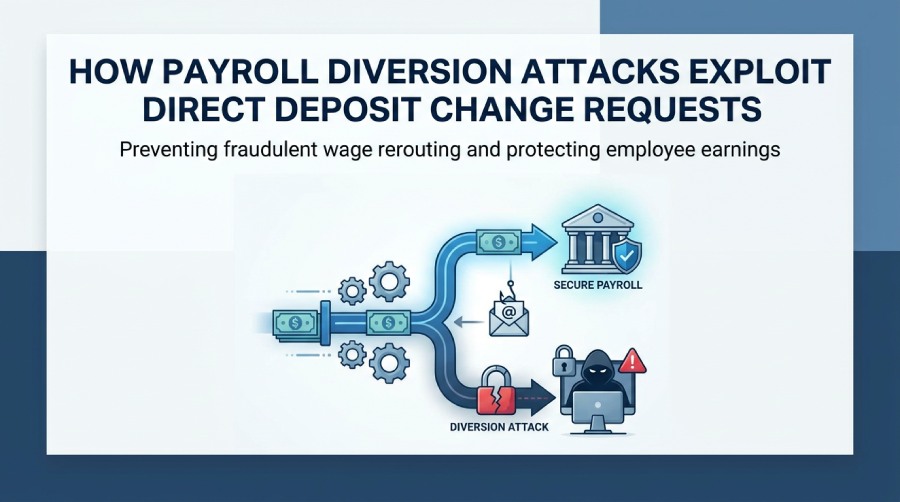
Payroll diversion scams target routine direct deposit updates to reroute employee wages to fraudulent bank accounts. Using phishing, business email compromise, or employee impersonation, criminals may trick HR and payroll teams into approving unauthorized changes. Knowing how these scams work, spotting warning signs, and using strong verification controls can help organizations prevent payroll fraud and protect employee earnings.
What Payroll Diversion Scams Are and Why Direct Deposit Requests Are a Prime Target
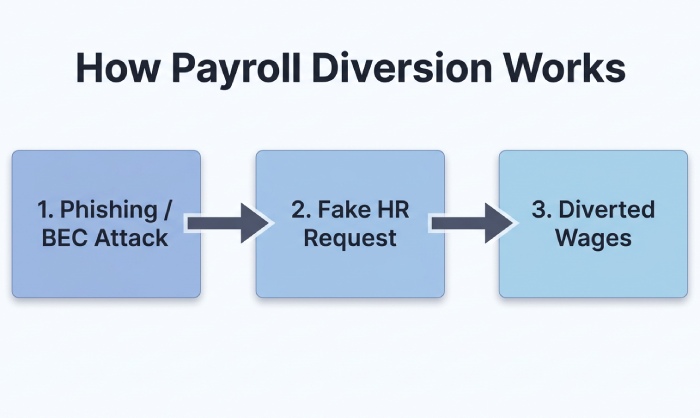
Payroll diversion is a form of financial fraud in which criminals redirect an employee’s wages to an account they control. A payroll diversion scam often begins with a phishing email, stolen login, or impersonation attempt that tricks the HR department or payroll department into processing a fraudulent direct deposit update. Because direct deposit changes are routine in employee payroll administration, attackers exploit the normal workflow to hide direct deposit fraud in plain sight.
A payroll diversion scam is especially effective because payroll processing depends on trust, speed, and predictable deadlines. Employees frequently update bank details after changing banks, opening new accounts, or adjusting allocations for savings, Health Savings Accounts, CDs & IRAs, or retirement planning such as IRA & 401k Rollovers. Criminals understand this and submit a bank account change request that appears ordinary, urgent, and employee-driven.
Why Direct Deposit Is So Attractive to Criminals
Direct deposit fraud gives attackers a fast path to money. Once a fraudulent direct deposit is accepted before payroll closes, wages may be routed through ACH fraud channels to a mule account, prepaid card, or online banking account opened with stolen information. Unlike wire transfer fraud, which may trigger more scrutiny, employee payroll changes are often treated as administrative updates rather than high-risk transactions.
This is why payroll scams overlap heavily with business email compromise. In a business email compromise scenario, a criminal may impersonate an executive, employee, or third-party payroll service provider to request unauthorized payroll changes. The same social engineering tactics used in an email scam can also support a human resources scam, payroll department scam, or payroll system attack.
Financial institutions such as Mercantile Bank and business banking teams may provide tools like Cash Management, Positive Pay, Remote Deposit Capture, Bill Pay, Mobile Wallet, Beacon Alerts, ICS, CDARS, Business Credit Cards, and account monitoring services, but organizations still need strong internal payroll security to prevent payroll diversion at the source.
How Attackers Impersonate Employees to Submit Fraudulent Bank Account Changes
Attackers usually begin by gathering employee information and compromised data from social media, prior breaches, phishing, or compromised credentials. They may learn an employee’s title, manager, work schedule, payroll cycle, and preferred communication style. With that context, the criminal submits a bank account change request that looks believable enough for employee payroll staff to process.
Common Impersonation Methods
A payroll diversion scam may involve a spoofed email address that closely resembles the employee’s real address. In other cases, the attacker uses an actual account takeover after stealing credentials through a phishing email. When compromised credentials are used to access an employee portal, the payroll redirection may appear legitimate because it originates from the employee’s profile.
Attackers may also call the HR department pretending to be locked out of online banking or payroll systems. They might claim they need a new account connected to UCB Mobile Banking, Google Play payment access, a Visa card, an Everyday Points Visa, Gift Cards, or another financial product. The details are often irrelevant, but they create urgency and realism around the fraudulent request.
The Role of Business Email Compromise
Business email compromise is one of the most common pathways into payroll fraud. In a business email compromise attack, the criminal may send a message such as: “I changed banks and need my paycheck sent to this new account starting immediately.” The email may include a voided check image, fake account documentation, or an attachment that looks like a secure payroll form.
Because business email compromise attacks often avoid malware and rely on social engineering, traditional filters may not stop them. This is where cybersecurity awareness, phishing protection, multifactor authentication, and user verification become essential layers of payroll protection.
Common Red Flags in Payroll Change Requests, Emails, and Employee Portal Activity
Payroll diversion often leaves clues. The challenge is training HR and payroll teams to recognize suspicious activity before unauthorized payroll changes become unauthorized transactions.
Email and Message Red Flags
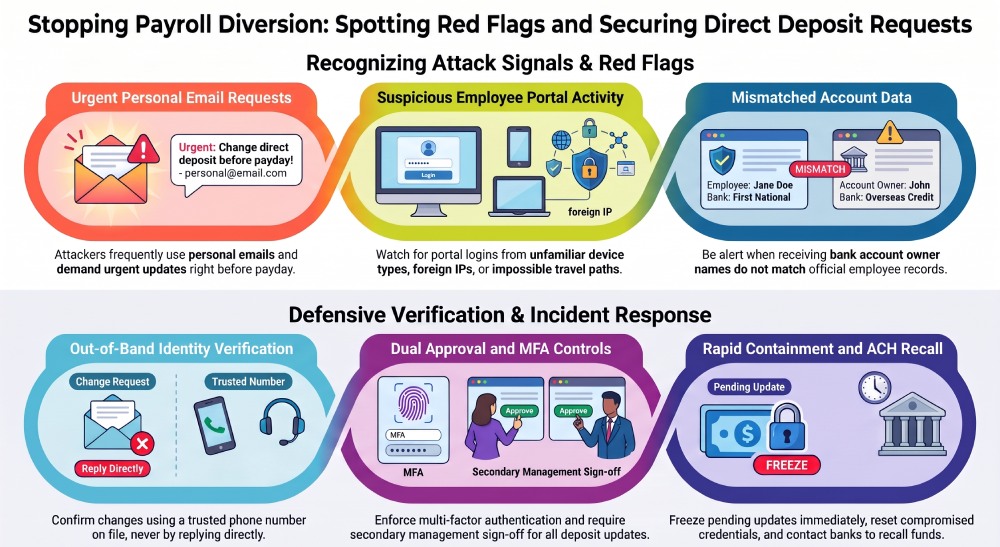
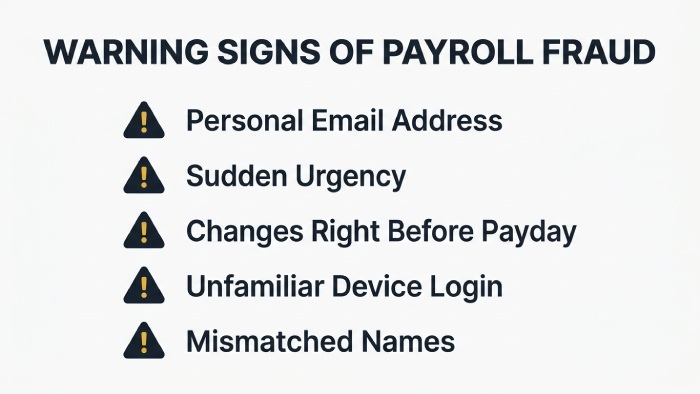
A suspicious bank account change request may come from a personal email address instead of the employee’s corporate account. It may pressure the payroll department to act quickly, avoid phone calls, or bypass standard payroll compliance steps. Poor grammar, unusual tone, or a sudden request to update employee payroll details immediately before payday can indicate direct deposit fraud.
Other warning signs include:
- A fraudulent request to split pay into a new account with no prior notice
- A request sent outside normal business hours
- A sudden change to direct deposit followed by silence from the employee
- Mismatched names between the employee and the receiving account
- A new bank account diversion request from an employee who rarely changes payroll details
Portal and Access Red Flags
In employee self-service portals, red flags include logins from unfamiliar devices, impossible travel activity, failed login spikes, or changes made from foreign IP addresses. These may signal payroll account takeover, account takeover, or a broader payroll system attack. If access controls are weak, a criminal may update employee payroll details without contacting HR at all.
Banking and Transaction Red Flags
After payroll processing, fraud detection teams should watch for rejected ACH entries, new account patterns, or employee complaints about missing wages. Business banking products and services such as Beacon Alerts, Positive Pay, Cash Management dashboards, and account monitoring can help identify suspicious activity tied to direct deposit fraud, ACH fraud, or bank account diversion.
Payroll scams can also intersect with other fraud categories, including internal fraud, employee benefit fraud, wire transfer fraud, and unauthorized transactions involving Business Loans, Commercial Loans, Personal Loans, VA Loans, Construction Loans, Home Equity Loans, or a Loan Payment Request if credentials are reused across systems.
Verification Controls HR and Payroll Teams Should Use Before Updating Direct Deposit Details
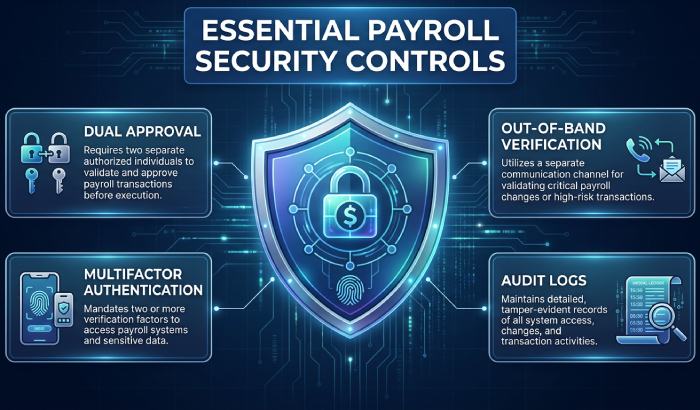
Preventing payroll diversion requires a documented process that treats every bank account change request as a high-risk event. The goal is not to slow payroll processing unnecessarily, but to create secure payroll workflows that stop unauthorized payroll changes before funds move.
Required Verification Steps
HR and payroll teams should verify every direct deposit update through a trusted channel already on file—not by replying to the original email. If an employee submits a bank account change request by email, staff should call the known phone number in the HR system, use an authenticated employee portal, or require in-person confirmation.
Strong user verification should include:
- Multifactor authentication for employee payroll portals
- Role-based access controls for HR department and payroll department users
- Dual approval for any fraudulent direct deposit risk scenario
- Confirmation of account ownership before payroll redirection
- Audit logs for all payroll processing changes
- Incident reporting requirements for suspicious activity
Payroll service providers should also be required to maintain cybersecurity controls, information security standards, and documented scam prevention procedures. Vendor agreements should clarify responsibilities for fraud detection, account monitoring, data protection, and rapid escalation after a payroll diversion scam.
Building a Secure Payroll Environment
A secure payroll program should combine people, process, and technology. Employee training should cover payroll scams, business email compromise, phishing email tactics, and direct deposit fraud. HR teams should understand how a human resources scam differs from ordinary employee requests, while finance teams should coordinate with business banking partners.
Organizations using Mercantile Bank services, Cash Management, Business Credit Cards, Mobile Wallet, Bill Pay, Remote Deposit Capture, Positive Pay, ICS, CDARS, or Beacon Alerts should align those tools with payroll security policies. Employees may also interact with products such as Zelle, Visa cards, Everyday Points Visa, Gift Cards, NMLS-related lending services, Professional Advisory Services, College Planning, Employee Benefits, and Health Savings Accounts, so identity verification should remain consistent across business resources.
Response Steps After a Payroll Diversion Attempt or Successful Fraud
When payroll diversion is suspected, speed matters. A delayed response can allow funds from a fraudulent direct deposit to move through multiple accounts, making recovery difficult. Whether the organization catches a payroll diversion scam before payday or after wages are misdirected, the response should follow a defined incident plan.
Immediate Containment and Investigation
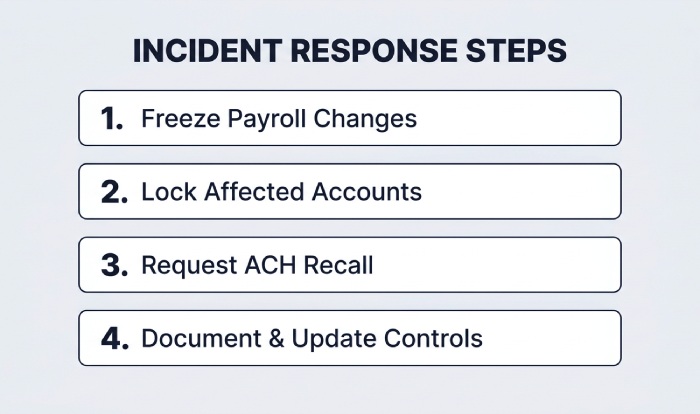
First, freeze any pending employee payroll changes related to the suspicious bank account change request. Disable affected accounts, reset passwords, revoke active sessions, and check for compromised credentials. If there is evidence of payroll account takeover or account takeover in connected systems, expand the review to online banking, HR platforms, employee benefits systems, and payroll service providers.
The payroll department should confirm the legitimate employee’s correct direct deposit details using a trusted contact method. If payroll fraud has already occurred, contact the bank immediately to request ACH recall support and trace the funds. Business banking representatives may also help review account monitoring alerts, unauthorized transactions, and suspicious activity tied to direct deposit fraud or bank account diversion.
Reporting, Recovery, and Prevention Updates
Document the incident thoroughly. Incident reporting should include the timeline, affected employee payroll records, email headers, portal logs, IP addresses, bank account details, and whether the attempt involved business email compromise, social engineering, internal fraud, or a payroll department scam.
Organizations should also notify relevant stakeholders, which may include legal counsel, cybersecurity teams, payroll service providers, insurance carriers, and law enforcement. If an employee information compromise occurred, review breach notification obligations and payroll compliance requirements.
After containment, update controls to prevent repeat payroll scams. Add multifactor authentication where missing, strengthen access controls, improve user verification scripts, and require secondary approval for every bank account change request. Review whether the payroll diversion scam exposed gaps in information security, employee training, fraud detection, or secure payroll processes.
A successful response does more than recover funds. It reduces the likelihood of future payroll diversion, direct deposit fraud, payroll fraud, fraudulent direct deposit attempts, and unauthorized payroll changes across the organization.
General Manager
General Manager of DuoCircle. Product strategy and commercial lead across DuoCircle's 2,000+ customer base.
LinkedIn Profile →Protect your inbox from phishing attacks
Real-time email security with 60-day free trial. No credit card required.