How Machine Learning Improves Modern Email Security Solutions

Quick Answer
Machine learning improves modern email security by detecting phishing, malware, spam, and suspicious behavior in real time. It analyzes patterns, sender reputation, and user activity to stop advanced cyber threats before they reach inboxes.
Modern email security depends on fast, context-aware decisions across Microsoft 365, Google Workspace, and hybrid environments. Traditional rule-based filtering still has value, but today’s threat landscape includes phishing, ransomware, BEC, account takeover, zero-day attacks, and other advanced threats that change too quickly for static controls alone. Machine learning improves email protection by analyzing patterns, user behavior, message metadata, attachments, links, and historical threat intelligence at scale.
Leading email security platforms from vendors such as Proofpoint, Mimecast, Abnormal Security, Check Point Harmony, Cisco, Symantec, and Microsoft increasingly combine secure email gateway controls, API protection, and cloud-based security models. Whether deployed as a SEG, through API integration, or via deployment via API into M365 and Google Workspace, AI-powered security gives security teams better visibility, faster threat detection, and more adaptive risk management.
Detecting Phishing and Business Email Compromise with Pattern Recognition
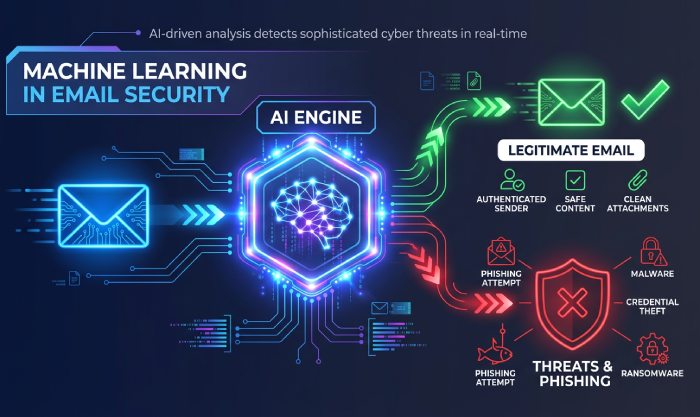
Phishing remains one of the most common cyberthreats because it exploits trust, urgency, and human behavior. Machine learning strengthens email security and phishing protection by recognizing subtle patterns across sender reputation, message tone, domain similarity, authentication signals, and historical attack data.
Recognizing impersonation and social engineering signals
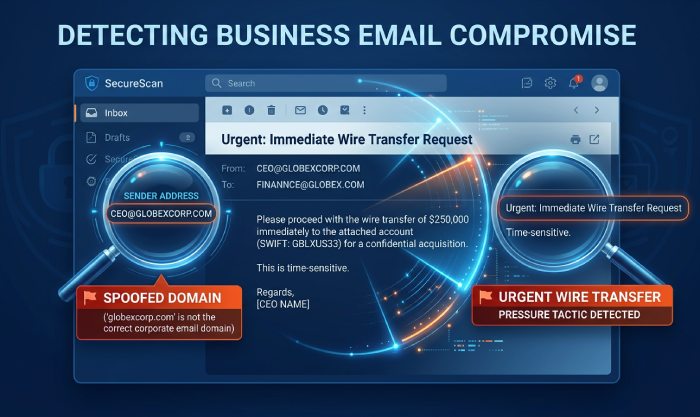
BEC, or business email compromise, often lacks obvious malware or suspicious attachments. Instead, BEC relies on identity deception, executive impersonation, invoice fraud, and payment redirection. Machine learning models can detect BEC by comparing email content, sender behavior, writing style, and communication history against known baselines.
Pattern recognition beyond keywords
Older email protection systems often searched for specific phrases or known bad domains. Modern AI-powered security evaluates deeper indicators, including:
- Lookalike domains and display-name spoofing
- Unusual payment language or wire-transfer requests
- Sender-recipient relationship anomalies
- Time-of-day inconsistencies
- Changes in tone, grammar, or business process context
Reducing exposure to phishing campaigns
When phishing campaigns target large organizations, such as Fortune 100 enterprises or global teams across the Americas, pattern recognition helps identify coordinated attack waves. This improves threat detection before a data breach occurs and supports compliance, reporting, and incident response requirements.
Identifying Malware, Suspicious Attachments, and Malicious Links in Real Time
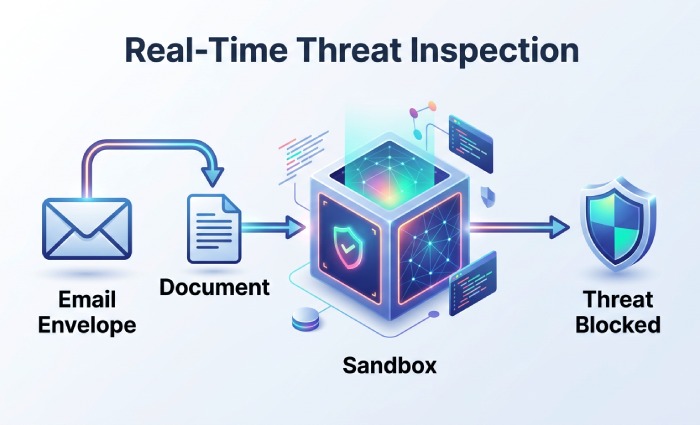
Email remains a major attack vector for ransomware, credential theft, and malware delivery. Machine learning improves real-time protection by analyzing files, URLs, scripts, and payload behavior before users interact with dangerous content.
Detecting malware and ransomware before execution
Advanced threats often use evasive techniques such as polymorphic malware, password-protected archives, weaponized documents, and delayed URL activation. Email security systems now use sandboxing, static analysis, dynamic analysis, and threat intelligence feeds to identify ransomware and malware variants quickly.
Link analysis and attachment inspection
A modern email protection platform can evaluate:
- URL redirects and domain age
- File reputation and hash similarity
- Macro behavior in office documents
- Embedded scripts and payload staging
- Known ransomware infrastructure
Applying intelligence across the threat lifecycle
Threat intelligence helps security teams understand the full threat lifecycle, from initial delivery to credential harvesting, lateral movement, and data exfiltration. Platforms such as Proofpoint Nexus, Threat Protection Workbench, and Prime Threat Protection demonstrate how threat intelligence and forensics can support faster investigation and automated response.
Using Behavioral Analysis to Spot Account Takeovers and Anomalous Activity
Account takeover is one of the most damaging outcomes of successful phishing. Once attackers gain valid credentials, they can bypass perimeter defenses, access sensitive data, launch internal phishing, and escalate toward ransomware or data security incidents.
Establishing normal user behavior
Behavioral analysis improves email security by learning how employees normally use email and collaboration tools. In Microsoft 365, Google Workspace, and M365 security environments, models can evaluate login patterns, device usage, geolocation, mailbox rules, OAuth app activity, and sending behavior.
Detecting compromised accounts
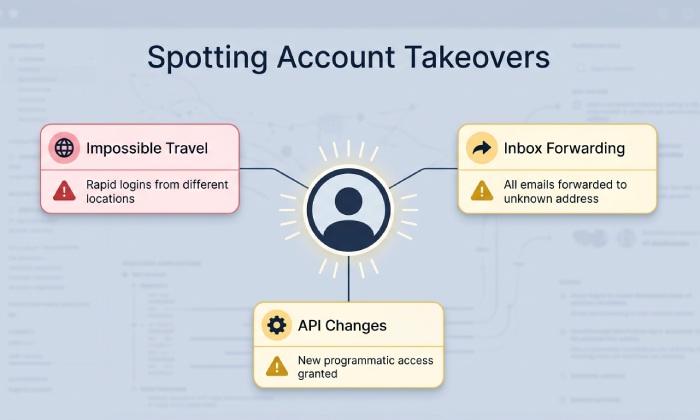
Account takeover detection often looks for:
- Impossible travel or unusual login locations
- Sudden mailbox forwarding rules
- Abnormal internal message volume
- Suspicious API permissions
- Changes in communication patterns
- New access to sensitive repositories
Supporting identity protection and collaboration security
Because attackers increasingly move through email, chat, file-sharing, and SaaS applications, email protection must connect with identity protection, collaboration security, Microsoft Purview, DLP, and broader security framework controls. Legacy DLP alone is not enough when account takeover activity spans email, cloud apps, and identity systems.
Reducing False Positives Through Adaptive Filtering and Continuous Learning
Effective email security must block cyberthreats without disrupting business communication. If security tools generate too many false positives, users lose trust, productivity drops, and the end user experience suffers.
Learning from user, analyst, and system feedback
Machine learning continuously improves filtering decisions by learning from confirmed malicious messages, user reports, SOC investigations, abuse mailbox submissions, and analyst verdicts. This allows email protection to adapt to changing phishing tactics, spam campaigns, graymail patterns, and BEC techniques.
Balancing protection and usability
Adaptive filtering improves customization by allowing different policies for executives, finance teams, legal departments, and high-risk users. It also improves visibility into why a message was blocked, quarantined, or delivered with a warning banner.
Enhancing SOC efficiency
For a security operations center, fewer false positives mean less alert fatigue and better focus on advanced threats. Automated response can remove malicious messages from inboxes, revoke sessions after account takeover, quarantine suspicious files, and trigger incident response workflows before ransomware spreads.
Strengthening Email Security with Human-AI Collaboration and Threat Intelligence
The strongest email security programs combine human-centric security, agent-centric security, machine learning, and expert threat intelligence. AI can process massive volumes of data, but human analysts provide context, judgment, and business understanding.
Combining AI models with analyst expertise
Threat intelligence from vendors, internal telemetry, and global research helps detect phishing, BEC, ransomware, and other cyberthreats faster. Gartner, IBM, Ponemon, and RSA research frequently emphasize that advanced threats require layered controls, measurable risk management, and operational maturity—not just another standalone tool.
Integrating email protection into the broader stack
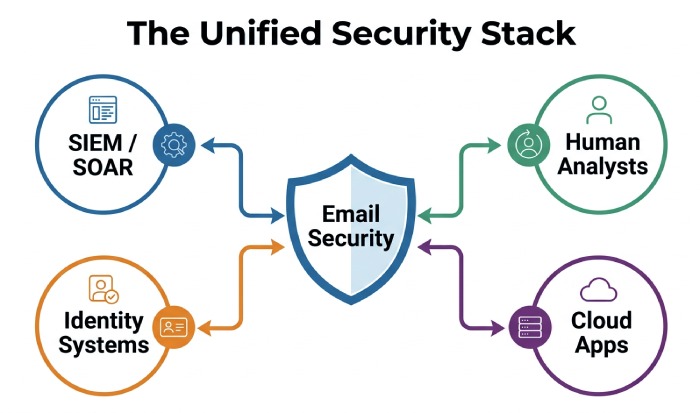
Modern email security should integrate with:
- SIEM and SOAR platforms
- Secure email gateway infrastructure
- API protection for Microsoft 365 and Google Workspace
- DLP and Microsoft Purview
- SSE Vendors and DSPM Vendors
- SOC workflows and forensics tools
- Identity and access management systems
Examples of emerging agentic workflows
Agentic Automation is beginning to reshape how organizations triage abuse mailbox reports and coordinate remediation. Tools and concepts such as the Satori Abuse Mailbox Agent, Satori, and platforms backed by firms like Celesta Capital reflect a broader movement toward agent-centric security, where AI agents assist analysts with classification, enrichment, reporting, and response.
Building unified protection against modern email threats
Unified protection brings together secure email gateway controls, API-based inspection, cloud-based security, threat intelligence, behavioral analysis, and automated response. This layered approach improves data security, reduces the likelihood of a data breach, and gives organizations stronger defenses against phishing, ransomware, BEC, account takeover, and emerging advanced threats.
General Manager
General Manager of DuoCircle. Product strategy and commercial lead across DuoCircle's 2,000+ customer base.
LinkedIn Profile →Protect your inbox from phishing attacks
Real-time email security with 60-day free trial. No credit card required.