How Generative AI Is Changing Phishing Attacks—And How AI Defends Against Them

Quick Answer
Generative AI is enabling cybercriminals to create highly convincing phishing emails, messages, and deepfakes at scale. At the same time, AI-powered security tools analyze behavior, detect suspicious patterns, and block phishing threats before they reach users.
Artificial intelligence is reshaping the landscape of cybersecurity on both offense and defense. On one hand, generative AI enhances the capabilities of organizations in detecting threats and streamlining security processes. On the other hand, it equips cybercriminals with sophisticated tools for crafting highly convincing phishing schemes. This includes AI-generated emails, deepfake audio messages, and tailored social engineering tactics that are increasingly difficult to recognize as fraudulent.
As these phishing threats become more advanced, businesses need to implement equally sophisticated protective measures. Contemporary AI-driven security systems leverage machine learning, behavioral analytics, and real-time threat intelligence to identify suspicious behavior before it can result in compromised accounts or stolen data. This article delves into how generative AI is revolutionizing phishing attacks, the reasons these threats are harder to identify, and the preventive strategies organizations can adopt to enhance their security.
The New Phishing Landscape: How Generative AI Makes Attacks More Convincing
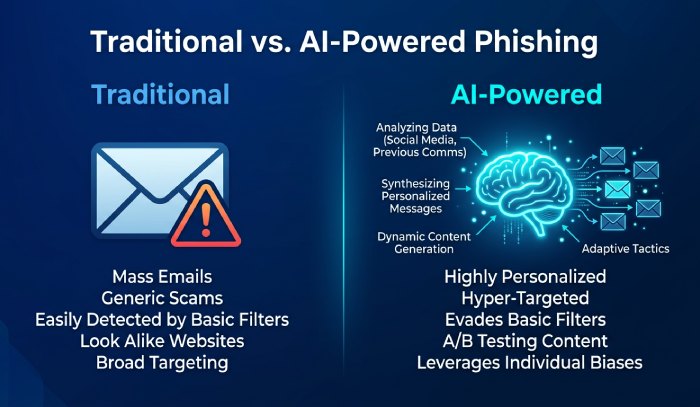
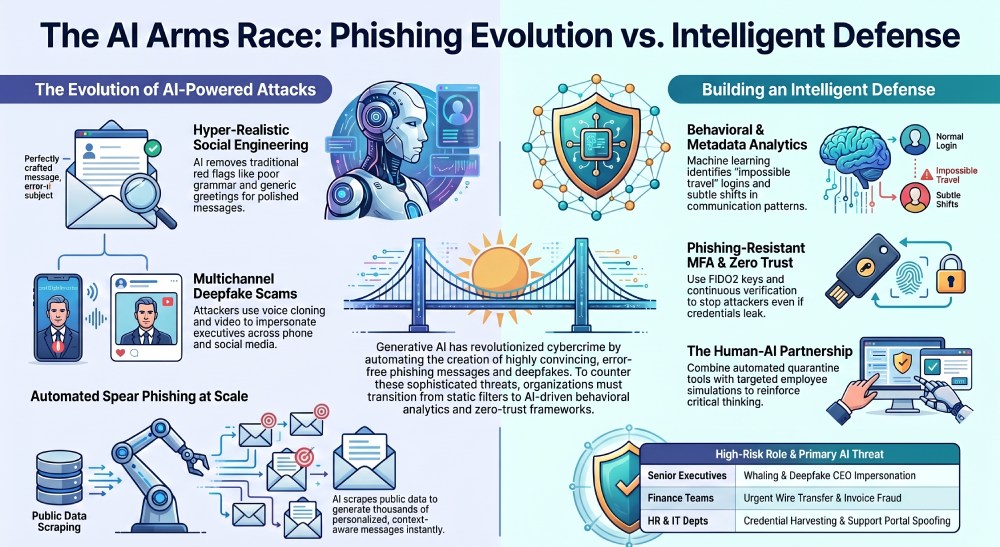
Generative artificial intelligence has reshaped the phishing threat landscape by lowering the skill barrier for cybercriminals and increasing the realism of phishing scams. In the past, many phishing emails were easy to spot because of awkward grammar, generic greetings, or poorly formatted messages. Today, AI-powered phishing campaigns can use natural language generation to produce polished, context-aware messages that look like they came from a trusted colleague, vendor, bank, or executive.
This shift is especially dangerous for spear phishing and whaling. Spear phishing targets a specific employee or small group, while whaling focuses on senior executives, finance leaders, legal teams, and other high-value decision-makers. With artificial intelligence, attackers can quickly analyze public data from LinkedIn, Facebook, company websites, press releases, and breach dumps to craft personalized phishing messages that appear highly credible.
AI-powered phishing also enables automation in phishing at a scale that traditional attackers could not easily achieve. Cybercriminals can generate thousands of tailored phishing scams, test different emotional triggers, and refine messages based on responses. A request for invoice payment, password reset, document review, or confidential information request can be customized to match a target’s role, writing style, and business context.
Why AI-Powered Phishing Is Harder to Detect
AI-powered phishing is difficult to identify because it often avoids the obvious phishing indicators users were trained to notice. The language is fluent, the tone is professional, and the message may reference real projects, known vendors, or internal processes. Attackers can also create lookalike domains, use email spoofing, and embed malicious links that appear legitimate at first glance.
Traditional advanced spam filters still matter, but they are no longer enough by themselves. Modern email security must account for behavioral signals, metadata analysis, anomaly detection, and business context—not just suspicious keywords or known malicious URLs.
AI-Generated Social Engineering: Personalization, Deepfakes, and Multichannel Scams
AI has expanded social engineering beyond email. Cybercriminals now combine phishing emails, voice cloning, deepfake videos, chatbot impersonation, and social media phishing to pressure victims across multiple channels. For example, a target may receive a convincing email from a “manager,” followed by a message on LinkedIn, then a phone call using a cloned voice.
This multichannel approach increases trust and urgency. Personalized phishing campaigns can reference recent meetings, job titles, public posts, or vendor relationships. Attackers may impersonate the IT department, Microsoft support, Office 365 administrators, or a known business partner to steal credentials or trigger account compromise.
Deepfake CEO Scams and Executive Impersonation
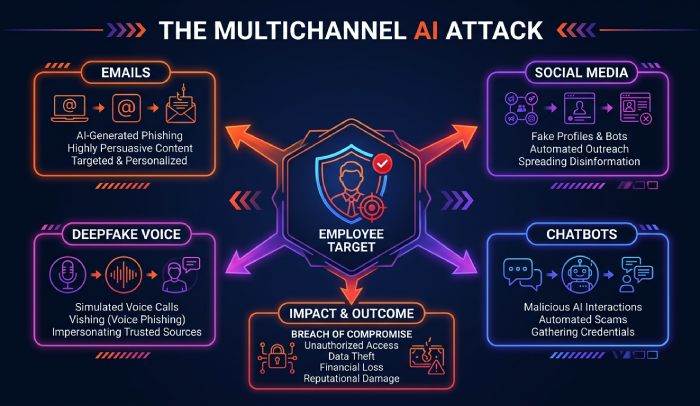
Deepfake CEO Scams are a growing concern in whaling attacks. In one widely reported case involving a European energy firm, attackers used AI-generated voice impersonation to convince an employee to transfer funds. As deepfake videos and voice cloning improve, whaling becomes more persuasive, especially when fraudulent requests appear to come from executives.
Common AI-Generated Attack Scenarios
Attackers frequently use artificial intelligence to create:
- Spear phishing emails that mimic a manager’s writing style
- Whaling messages requesting urgent wire transfers
- Chatbot impersonation on support portals or messaging platforms
- Social media phishing using fake recruiter or vendor profiles
- Fake privacy policy or compliance notices, sometimes referencing tools such as Cookieyes, to appear legitimate
The Role of Emotional Triggers
AI-powered phishing often uses emotional triggers such as urgency, fear, curiosity, authority, or financial pressure. A message may warn of password security issues, claim a security loophole was found, or demand immediate URL verification to prevent account compromise. These tactics reduce critical thinking and increase the chance that users will click on malicious links or disclose credentials.
AI-Powered Detection: Using Machine Learning to Spot Suspicious Content and Behavior
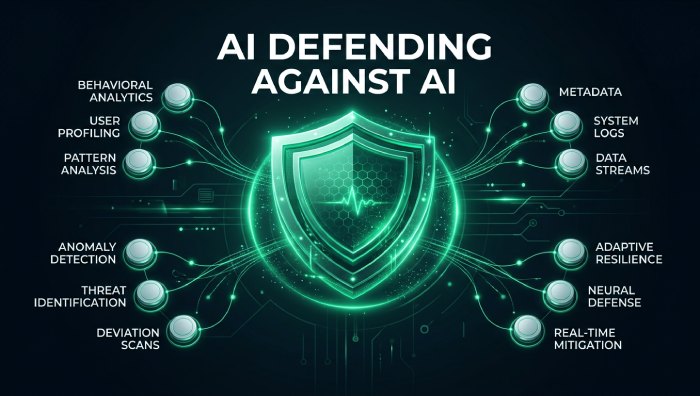
The same artificial intelligence that enables cybercrime is also strengthening phishing detection. Modern AI security tools use machine learning, data analysis, and behavioral modeling to identify threats that static rules might miss. Instead of only scanning for known bad links, machine learning systems evaluate patterns across users, devices, domains, message content, sender reputation, and historical behavior.
Email security platforms such as Microsoft Defender for Office 365, Proofpoint, and Barracuda Sentinel use AI and ML to detect phishing emails, business email compromise, email spoofing, and suspicious login behavior. These security tools can identify anomalies such as an executive sending payment instructions from an unusual location or a vendor invoice arriving from a newly registered lookalike domain.
Real-Time Threat Detection and Behavioral Analytics
Real-time threat detection is essential because AI-powered phishing campaigns can change quickly. Machine learning models can flag unusual behavior, including impossible travel logins, abnormal attachment patterns, unexpected forwarding rules, and sudden changes in communication style.
Metadata Analysis and Anomaly Detection
Metadata analysis helps email security systems evaluate sender infrastructure, domain age, authentication records, reply-to mismatches, and message routing. Anomaly detection can then identify when a message appears inconsistent with normal business communication. These methods improve phishing detection even when the content itself looks clean.
AI-powered phishing is not limited to known threats, so defenders need adaptive models that learn from new Cybersecurity threats. Cybersecurity advisories from Microsoft, EC-Council, and other Cybercrime experts can also inform detection rules and threat intelligence feeds.
Prevention Techniques: Email Security, User Risk Scoring, and Real-Time Threat Intelligence
Strong phishing prevention techniques require layered controls. Email security remains the first line of defense, but organizations must also use identity protection, user risk scoring, endpoint telemetry, and threat intelligence. A mature program combines advanced spam filters with AI-based phishing detection and automated response workflows.
Core Phishing Prevention Techniques
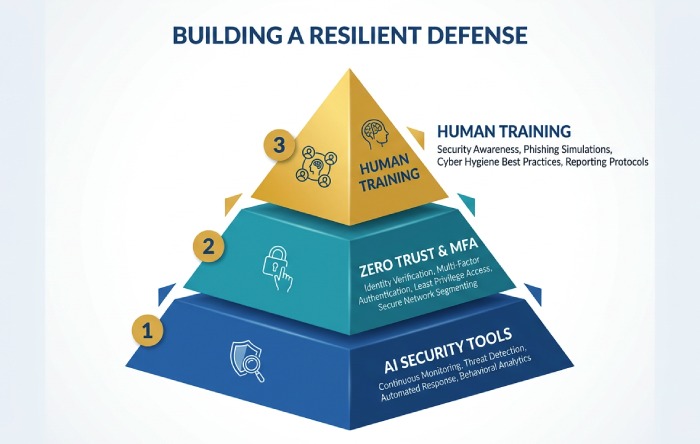
Effective phishing prevention techniques include:
- Enforcing multi-factor authentication, preferably phishing-resistant FIDO2 keys
- Applying a zero-trust framework based on least privilege and continuous verification
- Using URL verification and link rewriting to inspect malicious links
- Blocking lookalike domains and suspicious sender infrastructure
- Monitoring for account compromise and unusual login behavior
- Strengthening password security and credential hygiene
- Reviewing third-party access and vendor communication processes
Zero Trust and Multi-factor Authentication are especially important because even successful phishing scams should not automatically give attackers access to sensitive systems. A Zero Trust model assumes no user, device, or session is inherently trusted.
User Risk Scoring and Threat Intelligence
User risk scoring helps the Cybersecurity department prioritize protection for employees most likely to be targeted by spear phishing, whaling, and personalized phishing. Executives, finance staff, HR teams, and system administrators often face more targeted attacks and need enhanced controls.
Threat intelligence also improves phishing prevention techniques by tracking active campaigns, attacker infrastructure, and new tactics. When integrated with Microsoft Defender for Office 365, Proofpoint, Barracuda Sentinel, and other AI security tools, real-time intelligence can automatically quarantine phishing emails, warn users, or trigger an Incident Response Plan.
Building a Resilient Defense Strategy: Combining AI Tools, Human Training, and Incident Response
Technology alone cannot stop AI-powered phishing. A resilient defense strategy combines artificial intelligence, machine learning, strong email security, employee training, and a tested incident response plan. Human judgment remains critical because attackers design phishing scams to exploit trust, routine, and distraction.
Cybersecurity awareness programs should teach employees how spear phishing, whaling, and personalized phishing work in real business scenarios. Security awareness training should include examples of phishing emails, deepfake videos, social media phishing, chatbot impersonation, and fraudulent requests. Phishing simulation platforms can help measure readiness and reinforce user vigilance without blame.
Training, Governance, and Cyber Resilience
Organizations should invest in Cybersecurity awareness courses and role-based employee training for executives, finance teams, HR personnel, and IT department staff. Cybersecurity education providers such as EC-Council and EC-Council University offer programs, including an MBA in Cybersecurity, that help professionals understand cybercrime, AI-powered phishing, AI and ML defense strategies, and the evolving Cybersecurity Standard for risk management.
A practical Cyber resilience program should include:
- Regular phishing simulations tailored to real business workflows
- Clear reporting channels for suspicious emails and fraudulent requests
- A documented and tested Incident Response Plan
- Coordination between the IT department, legal, compliance, and leadership
- Playbooks for account compromise, email spoofing, and executive impersonation
- Ongoing review of security loopholes and policy gaps
Human Judgment Still Matters
Even with machine learning and artificial intelligence, users must verify unusual requests before acting. If a message asks for payment, credentials, confidential data, or urgent approval, employees should pause, validate the sender through a trusted channel, and report suspicious activity. Critical thinking, user vigilance, and strong email security together reduce the impact of cybercrime and make phishing protection techniques far more effective.
General Manager
General Manager of DuoCircle. Product strategy and commercial lead across DuoCircle's 2,000+ customer base.
LinkedIn Profile →Protect your inbox from phishing attacks
Real-time email security with 60-day free trial. No credit card required.